Pearson Edexcel · GCSE · Business
Course version: 1BS0 · Version from Sept 2017
Production processes: ● different types: job, batch, flow ● the impact of…
Full specification wording
Business operations: Production processes: ● different types: job, batch, flow ● the impact of different types of production process: keeping productivity up and costs down and allowing for competitive prices.
Businesses choose production methods based on their product and market.
Checked against the Pearson Edexcel 1BS0 specification (opens in a new tab) on .
- Point 2 of 3
- 3 key terms
Study notes
From the checked teaching notes for this specification point.
The idea
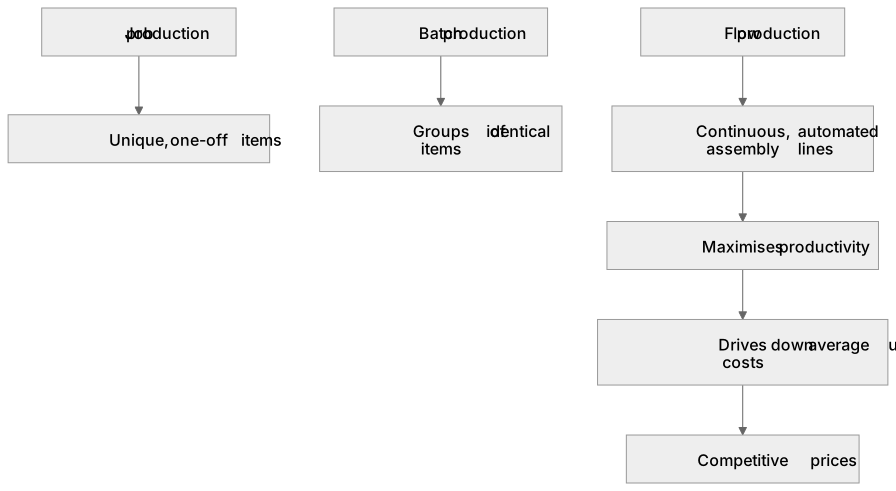
Businesses choose production methods based on their product and market. Job production creates unique, one-off items like custom wedding dresses, offering high quality but at a high unit cost. Batch production makes groups of identical items, such as a bakery producing 50 chocolate muffins before switching to blueberry, balancing variety with lower costs. Flow production involves continuous, automated assembly lines, like car manufacturing. This method maximises productivity and drives down average unit costs through economies of scale. By keeping costs low and productivity high, businesses using flow or large-scale batch production can set highly competitive prices, attracting price-sensitive customers while maintaining profit margins.
What earns the marks
- Define job, batch, and flow production with appropriate business examples.
- Explain how flow production increases productivity through automation and continuous operation.
- Analyse the link between high productivity, lower average unit costs, and the ability to charge competitive prices.
- Evaluate the trade-offs of each method, such as the high unit cost of job production versus the lack of flexibility in flow production.
Common mistakes and how to put them right
Confusing batch and flow production.
Put it right: Batch involves stopping and retooling between groups of products, whereas flow is continuous.
Assuming job production is always the most profitable.
Put it right: While profit margins per unit can be high, total profit may be lower due to low sales volume and high labour costs.
Stating that flow production guarantees high profits.
Put it right: Flow production lowers unit costs, but requires massive initial capital investment and high sales volumes to be profitable.
Exam tips
- Always link the chosen production method to the specific context of the business in the case study.
- When discussing competitive pricing, explicitly state how lower unit costs from flow or batch production allow a business to reduce selling prices without sacrificing profit margins.
- Use the term 'average unit cost' rather than just 'cost' when explaining the financial benefits of flow production.
Try the lesson
The start of the Business operations: Production processes: ● different types: job, batch, flow ● the impact of different types of production process: keeping productivity up and costs down and allowing for competitive prices. lesson, made from checked teaching notes for this specification point.
Have a go first
A bakery produces 500 identical chocolate muffins, then cleans the equipment to produce 500 identical blueberry muffins. Which type of production process is this?
Listen
Businesses choose production methods based on their product and market. Job production creates unique, one-off items like custom wedding dresses, offering high quality but at a high unit cost. Batch production makes groups of identical items, such as a bakery producing 50 chocolate muffins before switching to blueberry, balancing variety with lower costs. Flow production involves continuous, automated assembly lines, like car manufacturing. This method maximises productivity and drives down average unit costs through economies of scale. By keeping costs low and productivity high, businesses using flow or large-scale batch production can set highly competitive prices, attracting price-sensitive customers while maintaining profit margins. A strong answer earns marks for these points. Define job, batch, and flow production with appropriate business examples. Explain how flow production increases productivity through automation and continuous operation. Analyse the link between high productivity, lower average unit costs, and the ability to charge competitive prices. Evaluate the trade-offs of each method, such as the high unit cost of job production versus the lack of flexibility in flow production. A common slip: Confusing batch and flow production. Instead, batch involves stopping and retooling between groups of products, whereas flow is continuous. Exam tip: Always link the chosen production method to the specific context of the business in the case study.
See it
Key words
Say what each word means before you turn the card.
Job production
Try answering aloud or in your head before turning the card.
Batch production
Try answering aloud or in your head before turning the card.
Flow production
Try answering aloud or in your head before turning the card.
See every definition
- Job production
- Creating unique, one-off items like custom wedding dresses, offering high quality but at a high unit cost.
- Batch production
- Making groups of identical items, such as a bakery producing 50 chocolate muffins before switching to blueberry, balancing variety with lower costs.
- Flow production
- Continuous, automated assembly lines, like car manufacturing, which maximise productivity and drive down average unit costs through economies of scale.
Label the diagram
Some boxes have lost their names. Pick the right name for each number.
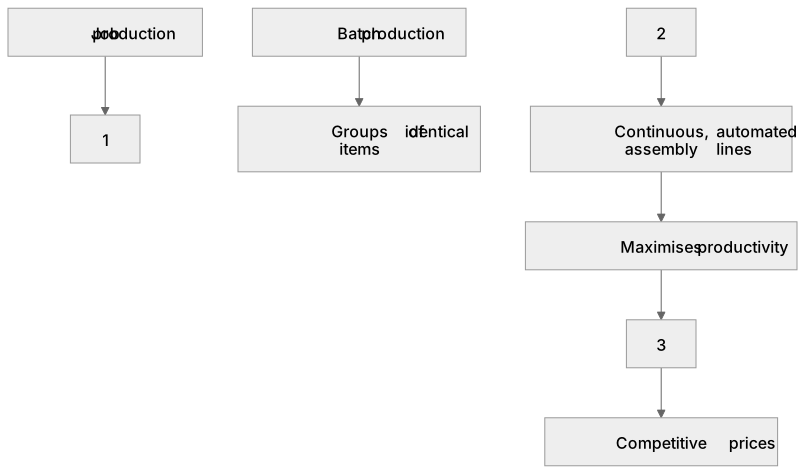
1Box 1
2Box 2
3Box 3
There is more to this lesson
The full lesson goes on to check your understanding and help you earn the marks. Create a free account to carry on, with your progress saved.
A week of Premium from your first lesson · Then the free plan continues · No card, no charge
Test your understanding of Business operations: Production processes: ● different types: job, batch, flow ● the impact of different types of production process: keeping productivity up and costs down and allowing for competitive prices.
Active recall beats re-reading. Take an instant quiz now to test what you’ve learned and lock it into long-term memory.
A week of Premium from your first lesson · Then the free plan continues · No card, no charge